
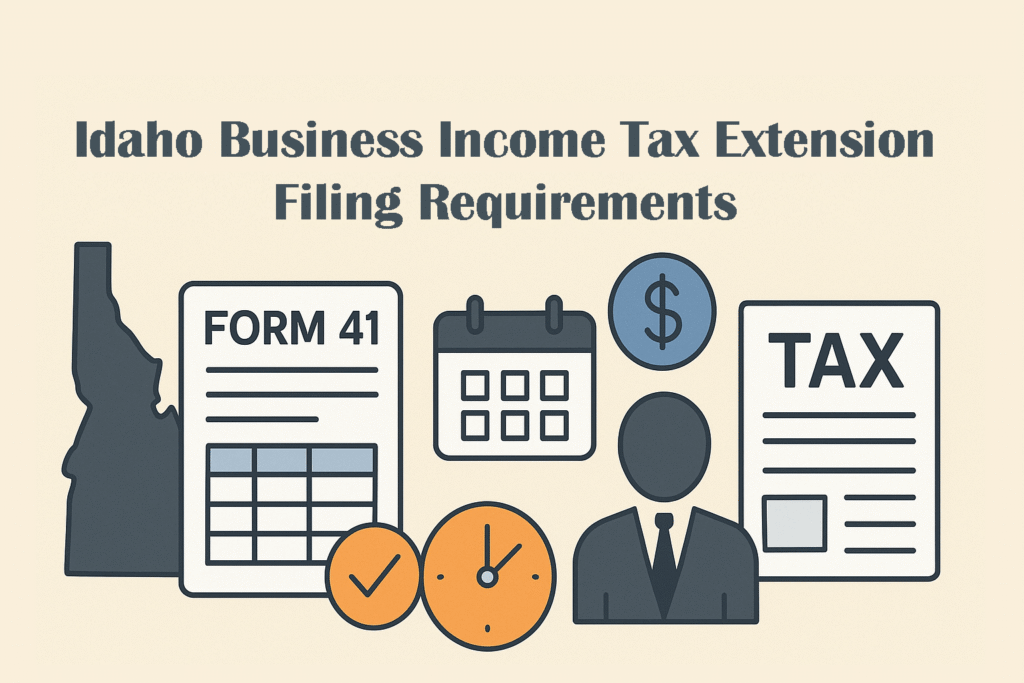
Idaho business owners, corporations, partnerships, and fiduciaries must stay compliant with the state’s income tax filing rules to avoid penalties and interest. If your business needs more time to file, Idaho offers an automatic extension—but only if key requirements are met.
This comprehensive guide explains everything about Idaho business tax extensions, filing deadlines, extension rules, penalties, and the specific income tax returns required for businesses operating in Idaho.
What Are the Idaho Business Income Tax Returns?
Idaho requires different income tax returns depending on your business entity type. Each form serves a specific purpose and includes its own filing requirements.
Form 41 – Corporation Income Tax Return
Form 41 is filed by C corporations doing business in Idaho.
This return reports taxable income, business activity in Idaho, apportionment factors, and Idaho tax liability. Corporations must file Form 41 even if they have no taxable income for the year. Idaho also requires estimated payments for many corporations, especially those anticipating a significant tax liability.
Form 41S – S Corporation Income Tax Return
Form 41S applies to S corporations operating in Idaho.
Although S corporations are pass-through entities and generally do not pay income tax at the entity level, they must still file Form 41S to report income, deductions, credits, and to provide Schedule K-1 information to shareholders.
For shareholders who are nonresidents of Idaho, additional reporting or withholding may be required.
Form 65 – Partnership Return of Income
Partnerships, including multi-member LLCs treated as partnerships for federal tax purposes, must file Form 65.
The form reports the partnership’s income and distributes each partner’s share through Idaho Schedule K-1. Partnerships do not pay income tax at the entity level, but the return is mandatory to ensure compliance and proper reporting for partners.
Form 66 – Fiduciary Income Tax Return
Form 66 is used by trusts and estates that are required to file state fiduciary income tax.
The fiduciary—such as a trustee, executor, or administrator—must report the entity’s income, deductions, taxable distributions, and Idaho tax liability. Even if no tax is due, Form 66 is required when Idaho filing thresholds are met.
When Is the Deadline to File Idaho State Business Tax Returns?
Different Idaho business entities follow the same general filing deadline.
Business Tax Returns 41, 41S, 65, and 66 must be filed on or before the 15th day of the fourth month following the close of the tax year.
For businesses operating on a calendar-year basis, this deadline falls on April 15, while fiscal-year filers must file by the corresponding fourth-month deadline based on their tax year-end.
Businesses can review additional filing rules directly from Idaho’s official guidance on business tax obligations.
Visit https://tax.idaho.gov/taxes/income-tax/business-income/guides-for-certain-businesses/
Does Idaho Allow an Extension to File Business Tax Returns?
Yes. Idaho allows an automatic six-month extension to file business income tax returns for corporations, pass-through entities, and fiduciaries. This extension applies only to filing, not to tax payments.
Important: Idaho Does Not Allow an Extension to Pay
Even with a valid extension,
- All taxes are still due by the original due date.
- Unpaid tax accrues interest until paid in full.
A valid extension helps you avoid the late filing penalty, but late payment penalties can still apply.
How Do You Qualify for a Valid Idaho Business Tax Extension?
To qualify for an automatic extension, your business must pay at least:
- 80% of your Idaho income tax liability, OR
- 100% of your total Idaho income tax reported on your previous tax year return
If you will owe $50 or less, a payment is not required—however, interest will still accrue on unpaid tax.
Failing to meet the minimum payment requirement means your extension will not be valid, and penalties can apply.
Using Form 41ES for Idaho Business Income Tax Payments
Idaho provides Form 41ES, a worksheet designed to help businesses calculate the required payment to secure a valid extension.
After calculating:
If a payment is due
You can:
- Mail the payment with the payment form at the bottom of the worksheet, OR
- Use Idaho’s free QuickPay online service to authorize a direct bank payment.
If no payment is needed
You do not need to submit Form 41ES.
Simply file your Idaho business tax return by the extended due date.
What to Do If You Don’t Have a Valid Extension
If you missed the original deadline and do not qualify for a valid extension:
- File your income tax return immediately.
- Pay as much of the tax due as possible.
(Even partial payments reduce penalties and interest.) - Review Idaho’s online payment options to make payments quickly.
Filing promptly can significantly reduce your penalty and interest exposure.
Visit https://tax.idaho.gov/taxes/income-tax/extension/ to learn more about Idaho business tax extension.
When Do Idaho Business Tax Penalties Apply?
Idaho imposes several penalties depending on the type of noncompliance. Understanding these is crucial for avoiding unnecessary costs.
5% per month, up to 25%
0.5% per month, up to 25%
2% per month from the due date to the payment date
10% penalty
5% penalty
50% penalty
Businesses may also use Idaho’s Penalty and Interest Estimator to calculate the estimated charges for late filing or late payment.
Final Thoughts
Idaho offers a generous six-month business tax extension, but only when the required prepayments are made by the original due date. Business owners must understand their entity-specific filing requirements, identify the correct form (Form 41, 41S, 65, or 66), and make timely tax payments to avoid costly penalties and interest. With proper planning—and by making estimated tax payments through Form 41ES or QuickPay—you can secure a valid Idaho business tax extension and stay fully compliant.
This comprehensive guide gives you all the information you need to navigate the Idaho business tax extension process accurately and confidently.