
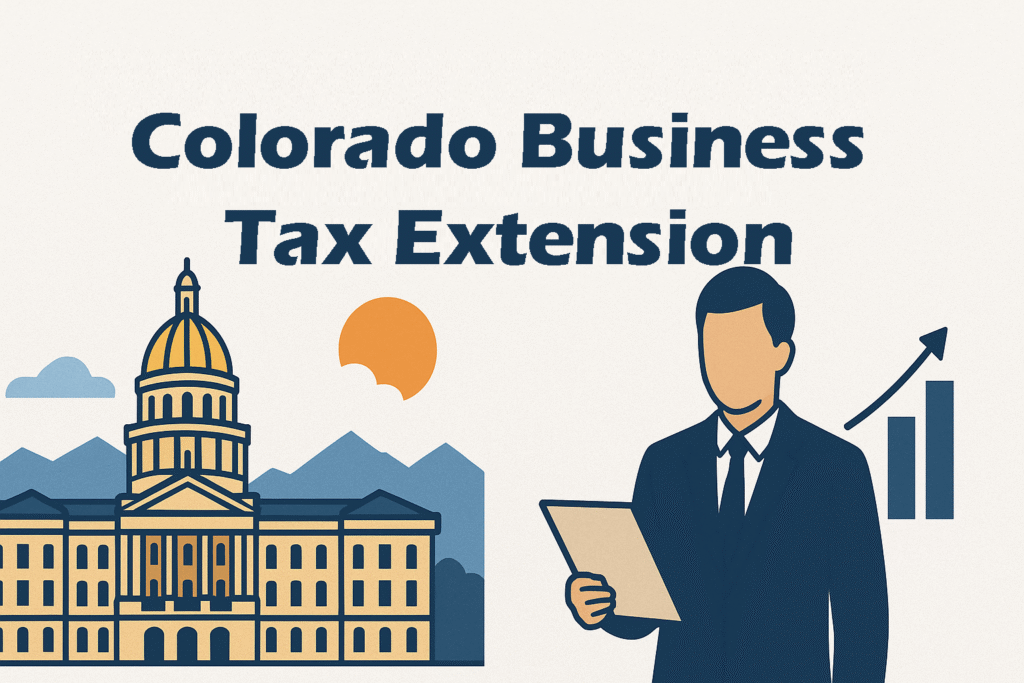
Colorado business owners often need more time to finalize their year-end financials, prepare accurate tax information, and organize supporting documents. Fortunately, the Colorado Department of Revenue (CDOR) offers a Colorado business tax extension, which gives qualifying entities additional time to file their state income tax returns—but not additional time to pay.
Whether you operate a corporation, partnership, S corporation, or fiduciary entity, understanding how the extension works—and how to use Colorado Forms DR 0158-C, DR 0158-N, and DR 0158-F—is crucial for avoiding penalties and staying compliant.
What Are Colorado Business Income Tax Returns?
Colorado imposes income tax on several types of business entities. These returns allow the state to calculate tax due based on the business’s Colorado-source income. Each entity type has a specific income tax return form and a specific extension payment form.
1. Corporations (C Corporations)
- File Form DR 0112 – Colorado Corporation Income Tax Return.
- Corporations operating in Colorado must report taxable income, apply apportionment rules if operating in multiple states, and pay Colorado corporate income tax.
2. S Corporations
- File Form DR 0106 – Colorado S Corporation Income Tax Return.
- While S corporations generally pass income through to shareholders, Colorado still requires the filing of an entity-level return for informational and composite tax purposes.
3. Partnerships
- File Form DR 0106 – Colorado Partnership Income Tax Return.
- Partnerships pass income through to partners, but the state still requires a business income tax return for reporting and withholding calculations.
4. Estates and Trusts (Fiduciary Returns)
- File Form DR 0105 – Colorado Fiduciary Income Tax Return.
- Fiduciaries must report business and non-business income that is taxable at the entity level.
Because each filing requires careful calculation and documentation, many businesses rely on a Colorado business tax extension to ensure accurate submission.
When Is the Deadline to File Colorado Business Income Tax Returns?
Colorado sets different filing deadlines depending on the business type:
1. Corporations (C Corporations)
- Tax years beginning on or after January 1, 2024:
- Due on the 15th day of the 5th month after year-end.
- Calendar-year filers: May 15.
- Earlier tax years:
- Historically due on the 15th day of the 4th month after year-end.
2. Partnerships & S Corporations
- Due on the 15th day of the 4th month after year-end.
- For calendar-year entities: April 15.
3. Estates & Trusts (Fiduciary Returns)
- Due on the 15th day of the 4th month after the end of the tax year.
- Calendar-year entities: April 15.
If the deadline falls on a weekend or holiday: The due date moves to the next business day.
These deadlines determine when payment is due, because Colorado does not extend the payment deadline even if you file under a Colorado business tax extension.
Can I Extend the Deadline to File Colorado Business Income Tax Returns?
Yes. Colorado provides an automatic six-month extension of time to file for most business entities. No special request is required.
However:
Colorado business tax extension = extra time to file, NOT extra time to pay
Tax payments must be submitted by the original due date, even if a complete return will be filed later.
Colorado uses the following extension payment forms:
- Form DR 0158-C – Extension Payment for C-Corporations
- Form DR 0158-N – Extension Payment for Composite Nonresident Tax (Partnerships/S-Corps)
- Form DR 0158-F – Extension Payment for Fiduciary Returns (Estates & Trusts)
These forms are only required if the business is making a payment with the extension. If the business pays online through Revenue Online and does not need to send a check, the form generally does not need to be mailed.
| Entity Type | Original Due Date | Extended Due Date |
| Corporations | May 15 | November 15 |
| Partnerships | April 15 | October 15 |
| S Corporations | April 15 | October 15 |
| Estates & Trusts | April 15 | October 15 |
This automatic extension allows more time to gather K-1s, complete multi-state apportionment, reconcile accounting entries, or finalize financial statements.
How to Make an Extension Payment for Colorado Business Tax Extension
Colorado requires payment by the original deadline—even when filing under a 6-month extension. Here’s how to make your payment:
Step 1: Estimate Your Tax Liability
Calculate the estimated tax due using:
- Year-end financials
- Estimated apportionment (if multi-state)
- Prior-year tax liability
- Expected distributive share (for pass-throughs)
Deduct prior payments such as:
- Estimated tax payments
- Withholding credits
- Credits carried forward
The balance remaining is the amount you must pay.
Step 2: Choose a Payment Method
Option A: Pay Online (Preferred)
- Use Colorado’s Revenue Online system.
- Fastest, most secure, and eliminates the need to mail Form DR 0158-C, DR 0158-N, or DR 0158-F.
Option B: Mail a Check or Money Order
- Payable to “Colorado Department of Revenue.”
- Include your FEIN or Colorado Account Number and the form year (e.g., “2024 DR 0158-C”).
- Attach to the correct extension form.
Step 3: Mail the Payment (If Not Paying Online)
All extension payments with forms are mailed to:
Colorado Department of Revenue
Denver, CO 80261-0008
Each form clearly displays the address and mailing instructions.
Step 4: Retain Proof of Payment
Always keep:
- Certified mail receipt or tracking (if mailing)
- Electronic confirmation (if paying online)
- Notations of payment amounts and dates
These support the business in case of audit, dispute, or penalty waiver request.
Penalties for Not Filing or Paying Colorado Business Income Tax on Time
Colorado enforces strict rules for businesses failing to meet filing or payment deadlines.
1. Penalties for Late Payment
If the business doesn’t pay its expected tax by the original due date, penalties begin immediately. Penalty rates vary annually and apply to:
- Underpayment of estimated taxes
- Late extension payments
- Late filing when tax is owed
2. Interest Charges
Interest accrues from the original due date, regardless of extension.
Even if the return is filed under a Colorado business tax extension, the interest clock starts ticking from:
- April 15 (for pass-throughs/estates/trusts), or
- May 15 (for corporations)
3. Failure-to-File Penalties
If the business misses the extended due date (e.g., October 15 or November 15):
- Additional penalties apply
- CDOR may treat the return as delinquent
- Persistent non-filing may trigger collection actions
4. Common Trigger Scenarios
Businesses usually incur penalties for:
- Misunderstanding that the extension covers payment (it does NOT)
- Underestimating tax due and paying too little
- Forgetting to file after receiving the extension
Final Thoughts
Filing Colorado business income tax returns on time—and making any required extension payments—is essential for staying compliant and avoiding unnecessary penalties. While the state automatically grants a six-month filing extension, it does not extend your time to pay. That’s why understanding the purpose of Colorado’s extension payment forms—DR 0158-C, DR 0158-N, and DR 0158-F—is crucial for corporations, pass-through entities, and fiduciaries.
By estimating your tax liability early, submitting your extension payment through Revenue Online or the correct DR 0158 form, and filing your return before the extended deadline, your business can remain in good standing with the Colorado Department of Revenue.
A proactive approach not only prevents penalty assessments but also gives your business the time needed to prepare accurate, complete, and stress-free tax filings.