
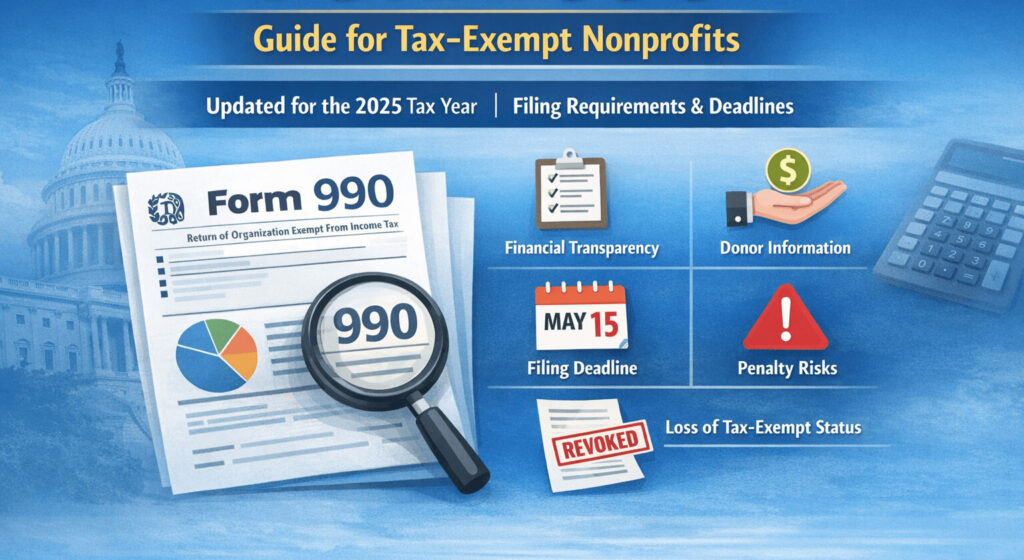
Form 990 is an annual information return filed with the Internal Revenue Service (IRS) by most tax-exempt organizations in the United States. It is the IRS’s primary tool for gathering financial and operational information from nonprofits, charities, and other tax-exempt entities — and for making that information available to the public.
Unlike a tax return filed by a for-profit business, Form 990 does not calculate taxes owed. Instead, it discloses the organization’s mission, programs, governance structure, revenue, expenses, assets, liabilities, and executive compensation. Think of it as a nonprofit’s annual transparency report submitted to the federal government.
Form 990 is a public document. Anyone can request a copy from the IRS, and filed returns are publicly available through databases such as ProPublica’s Nonprofit Explorer and the IRS Tax Exempt Organization Search tool.
Who Must File Form 990?
Most tax-exempt organizations are required to file an annual return from the this series. This includes:
- Section 501(c)(3) public charities (the most common nonprofit type)
- Section 501(c)(4) social welfare organizations
- Section 501(c)(6) trade associations and business leagues
- Section 501(c)(7) social and recreational clubs
- Section 527 political organizations
- Nonexempt charitable trusts that are not private foundations
The specific form you must file depends on your organization’s gross receipts and total assets — explained in the section on Form 990 variants below.
Who Is Exempt From Filing Form 990?
Certain organizations are not required to file any Form 990 series return. These include:
- Churches, conventions or associations of churches, and integrated auxiliaries of churches
- Organizations (other than private foundations) with annual gross receipts normally $50,000 or less — these may file Form 990-N (e-Postcard) instead
- State institutions whose income is excluded from gross income under section 115
- Certain governmental units and affiliates of governmental units
- Religious orders
Why Is Form 990 Important?
Form 990 serves multiple critical purposes for both regulators and the public:
| For the IRS & Regulators | For Donors & the Public |
|---|---|
|
|
Variants of Form 990
The IRS does not use a one-size-fits-all approach for nonprofit reporting. Instead, there are four versions of Form 990, and the correct one depends on your organization’s size, type, and financial activity.
1. Form 990-N (e-Postcard) — Smallest Organizations
Form 990-N is the simplest filing in the 990 series. It is an electronic postcard — not an actual paper form — that small exempt organizations can use to satisfy their annual reporting requirement.
Who qualifies: Tax-exempt organizations with annual gross receipts of $50,000 or less. Gross receipts are considered “normally” $50,000 or less if the organization has existed for 3+ years and averaged $50,000 or less over the past three years.
Form 990-N only requires eight pieces of basic information:
- Employer Identification Number (EIN)
- Tax year
- Legal name and mailing address
- Any other names the organization uses (DBA names)
- Name and address of a principal officer
- Website address (if applicable)
- Confirmation that annual gross receipts are $50,000 or less
- Statement if the organization has terminated or is terminating
There is no paper version of Form 990-N. Submit it electronically through the IRS e-Postcard system at IRS.gov using a Login.gov or ID.me account.
2. Form 990-EZ — Mid-Size Organizations
Form 990-EZ is a shorter version of the full Form 990. It serves organizations outgrowing the 990-N threshold but not requiring the full form.
Who qualifies: Organizations with gross receipts of less than $200,000 AND total assets of less than $500,000 at the end of the tax year.
Form 990-EZ covers income, expenses, assets, liabilities, program activities, officer compensation, and basic governance — but in a condensed format. Several schedules from the full Form 990 (A, B, C, E, G, L, N, O) may need to be attached depending on the organization’s activities.
Note: An organization eligible to file 990-EZ or 990-N can always choose to file the full Form 990 instead, if it prefers greater transparency
3. Form 990 — Larger Organizations
Form 990 is the full annual information return for larger tax-exempt organizations. It is the most comprehensive version and contains 12 parts plus numerous schedules.
Who must file: Organizations with gross receipts of $200,000 or more, OR total assets of $500,000 or more at the end of the tax year.
Organizations must also file the full Form 990 if they were required to do so in a prior year, regardless of current thresholds, or if mandated by IRS rules. Details appear in the “How to Complete Form 990” section below.
4. Form 990-PF — Private Foundations
Form 990-PF is filed by all private foundations — regardless of financial size. This includes domestic private foundations, taxable private foundations, and private foundations making transfers to another private foundation.
Who must file: All private foundations exempt under section 501(c)(3), including those with zero receipts or assets. This form is also filed by nonexempt charitable trusts treated as private foundations.
Form 990-PF is more complex than the standard 990 because it covers excise taxes on investment income, minimum distribution requirements, qualifying distributions, program-related investments, and private foundation-specific compliance rules.
5. Form 990-T — Unrelated Business Income Tax Return
Form 990-T is filed by tax-exempt organizations that earn $1,000 or more in gross income from a trade or business unrelated to their exempt purpose. Unlike the rest of the 990 series, it is an actual tax return — not just an information return — used to calculate and pay income tax on that unrelated business income (UBI).
Form 990-T is a separate filing from Form 990 and has a different due date: April 15 for calendar-year filers (the 15th day of the 4th month after the fiscal year ends), with a 6-month extension available via Form 8868.
Form 990 Series: Quick Selection Guide
| Form | Who Files | Threshold |
|---|---|---|
| 990-N | Small exempt orgs | Gross receipts ≤ $50,000 |
| 990-EZ | Mid-size exempt orgs | Receipts < $200K AND assets < $500K |
| 990 (Full) | Larger exempt orgs | Receipts ≥ $200K OR assets ≥ $500K |
| 990-PF | Private foundations | All private foundations (any size) |
| 990-T | Orgs with unrelated business income | Gross UBI ≥ $1,000 (due April 15, not May 15) |
More relevant topics: Which IRS Form 990 Does Your Nonprofit Need to File?
When Is the Deadline to File Form 990?
The due date for all variants of Form 990 follows the same basic rule:
Form 990 is due by the 15th day of the 5th month after the close of your organization’s tax year.
For calendar-year filers (organizations with a fiscal year ending December 31), this means:
Calendar-Year Deadline: May 15 of the following year. For example, for the 2024 tax year, the Form 990 is due May 15, 2025.
Fiscal-year filers’ deadlines shift—for example, June 30 means November 15.
Special Deadline Rules
- Weekend/Holiday Rule: If May 15 falls on a Saturday, Sunday, or federal legal holiday, the deadline moves to the next business day.
- Liquidated/Dissolved Organizations: File by the 15th day of the 5th month after the date of liquidation, dissolution, or termination.
- New Organizations: Even if your organization received its IRS determination letter late, the Form 990 filing obligation runs from the date the IRS considers the organization legally formed — typically when your EIN was established.
Additional Requirements for Filing Form 990
Filing Form 990 is not as simple as completing the core form. The IRS imposes several additional requirements — including attached schedules, public disclosure obligations, officer signatures, and state filing considerations.
Form 990 Schedules
Schedules are supplemental forms attached to Form 990 that require additional detail on specific areas of your organization’s activities. You do not complete all 16 schedules — only those that apply to your organization based on your answers in Part IV (the checklist) of the full Form 990.
The 16 schedules for Form 990 are:
| Schedule | Purpose |
|---|---|
| Schedule A | Public charity status and public support — required for all 501(c)(3) organizations filing Form 990 or 990-EZ |
| Schedule B | Schedule of contributors — reports contributions of $5,000+ from any single contributor during the tax year |
| Schedule C | Political campaign and lobbying activities — for 501(c)(3), 501(c)(4), and 527 organizations |
| Schedule D | Supplemental financial statements — donor-advised funds, conservation easements, art collections, endowments, and more |
| Schedule E | Schools — for 501(c)(3) private schools (racial nondiscrimination policy) |
| Schedule F | Statement of activities outside the U.S. — for organizations with foreign activities exceeding $10,000 in grants or $15,000 in program service revenue |
| Schedule G | Supplemental fundraising or gaming activities — professional fundraising, events, or gaming |
| Schedule H | Hospitals — for hospital organizations to report community benefit and other hospital-specific information |
| Schedule I | Grants and other assistance to domestic organizations, governments, and individuals exceeding $5,000 |
| Schedule J | Compensation information for certain officers, directors, and employees with total compensation over $150,000 |
| Schedule K | Tax-exempt bonds — for organizations with tax-exempt bond issues |
| Schedule L | Transactions with interested persons — business transactions or loans with officers, directors, or key employees |
| Schedule M | Noncash contributions — types and amounts of noncash contributions received during the year |
| Schedule N | Liquidation, termination, or dissolution — for organizations winding down or disposing of more than 25% of net assets |
| Schedule O | Supplemental information — required narrative explanations for questions throughout the core Form 990 (almost always required) |
| Schedule R | Related organizations and unrelated partnerships — for organizations with related entities or joint ventures |
Schedule O is the most universally required schedule. Most organizations that file Form 990 will need to attach Schedule O to provide explanations and supplemental details for various questions throughout the form./b>
Public Inspection Requirements
Form 990 is a public document. Tax-exempt organizations are required by law to make their three most recently filed Form 990 returns and their Form 1023 (or 1024) exemption application available for public inspection. Specifically
- Organizations must make these documents available during regular business hours at their principal office
- Copies must be provided upon written request (the organization may charge a reasonable fee for copying and mailing)
- Organizations with websites must post their Form 990 (and 1023) on their website in a format accessible to the public
- The IRS also makes filed returns available through the IRS Tax Exempt Organization Search tool
Signature Requirements
Form 990 must be signed by an authorized officer of the organization before filing. The return may be signed by the current president, vice president, treasurer, assistant treasurer, chief accounting officer, or another corporate officer (such as a tax officer). An unsigned return is treated as if it was not filed and may result in penalties
State Filing Requirements
Many states have their own charity registration and reporting requirements. In some states, your Form 990 can satisfy the state filing requirement, but you must separately register with the state’s charity regulator. Form 990, Part VI asks you to list every state with which the organization is required to file a copy of its return — this is your reminder that state compliance is separate from the federal IRS filing
Electronic Filing Requirements for Form 990
The IRS has moved to mandatory electronic filing for all 990 series returns. This was phased in over several years and is now fully in effect.
Current E-File Mandate
All organizations filing Form 990, 990-EZ, 990-PF, or 990-N for the 2025 tax year (and any subsequent year) are required to file electronically. Paper filing is no longer accepted for current-year returns./b>
Key points about electronic filing:
- Electronic filing is available only for the current tax year and 2 prior tax periods. Returns being amended or filed outside that window must be paper-filed.
- Amended returns filed for prior years beyond the 2-prior-year window must also be paper-filed.
- Form 990-N (e-Postcard) has always been electronic-only — there is no paper version.
- Do not password-protect or encrypt PDF attachments to e-filed returns, as this prevents the IRS from opening them.
How to E-File Form 990
Organizations can e-file Form 990 through IRS-authorized e-file providers. The IRS does not provide a free direct e-file portal for Form 990 (unlike individual 1040 returns). Options include:
- IRS-authorized commercial software: Third-party software providers authorized by the IRS to accept 990 series electronic filings. These cloud-based platforms support the full 990 series, automatically determine which schedules apply, and include built-in error checks before transmission.
- Tax preparers: Many CPA firms and nonprofit consultants use IRS-authorized software on behalf of their clients.
- Form 990-N (e-Postcard) only: Small organizations can file 990-N directly through the IRS e-Postcard system at IRS.gov/charities, using a Login.gov or ID.me account — at no cost.
To find a current list of IRS-authorized e-file providers for Form 990, visit IRS.gov and search for ‘Approved IRS e-file Providers for Forms 990.’ Always verify that a provider is IRS-authorized before submitting your return./b>
What Happens If You Try to Paper File?
The IRS will return paper Form 990, 990-EZ, or 990-PF submissions with a letter (Letter 2694C, 2695C, or 2696C) instructing the organization to refile electronically. You will have 10 days from the date of the letter to submit a complete and accurate return electronically. If you miss that window, penalties may apply.
Can I Extend the Form 990 Deadline?
Yes. Organizations that cannot complete their Form 990 by the original due date can request an automatic extension of time to file.
Use IRS Form 8868 (Application for Extension of Time to File an Exempt Organization Return) to request a 6-month automatic extension of time to file./b>
Key Facts About the Form 8868 Extension
- The extension request is automatic — the IRS does not need to approve it. If you timely and properly file Form 8868, you automatically receive the 6-month extension.
- For calendar-year filers, a 6-month extension moves the deadline from May 15 to November 15.
- Form 8868 must be filed by the original due date (e.g., May 15 for calendar-year filers). You cannot request an extension after the deadline has passed.
- Form 8868 can be filed electronically through IRS-authorized e-file providers, or on paper.
- The extension applies to all variants: Form 990, 990-EZ, 990-PF, and 990-T (unrelated business income tax return). Form 990-N does not require an extension — it is so simple that the IRS does not offer one.
Is There a Second Extension?
No. Unlike individual income tax returns, there is only one 6-month extension available for Form 990. Once you have taken the automatic 6-month extension, no additional extension is available. If your return is still not filed after the 6-month extension expires, you will begin accruing late-filing penalties from that date forward.
What Happens If You Don’t File Form 990 on Time?
The consequences of missing the Form 990 deadline range from financial penalties to complete loss of tax-exempt status. Organizations should treat the 990 filing deadline with the same seriousness as any other legal compliance obligation.
Financial Penalties for Late Filing
If an organization fails to file Form 990 on time and does not have a reasonable cause for the delay, the IRS imposes the following penalties:
| Organization Size | Daily Penalty | Maximum Penalty |
|---|---|---|
| Gross receipts under $1,208,500 | $20 per day | $12,000 or 5% of receipts |
| Gross receipts over $1,208,500 | $120 per day | $60,000 or 5% of receipts |
Note: The gross receipt thresholds above are adjusted for inflation periodically. Always verify the current year’s thresholds with the IRS or a qualified tax advisor.
Penalties for Failure to Disclose Required Information
If an organization files a Form 990 that is incomplete or fails to disclose required information, additional penalties may apply. The general penalty is $10 per day for each day the failure continues, with a maximum of $5,000 per return. The IRS may send a letter (Letter 2694C or similar) requiring a corrected return within 10 days.
Reasonable Cause Exception
Penalties can be waived if the organization can demonstrate reasonable cause for the late or incorrect filing. To request abatement, submit a written statement explaining the facts and circumstances that caused the delay. This can be attached to the return when filing or submitted in response to a penalty notice from the IRS. Common examples of reasonable cause include
- Death or serious illness of the person responsible for filing
- Unavoidable absence of the responsible person
- Fire, casualty, or natural disaster affecting records or ability to file
- Incorrect advice received from the IRS
Reputational and Donor Consequences
Beyond financial penalties, late or missing Form 990 filings have significant reputational consequences:
- Donors, foundations, and government grant agencies often check 990 filing history before awarding funds
- Watchdog organizations like Charity Navigator, GuideStar (Candid), and BBB Wise Giving Alliance may lower ratings or flag organizations with missing returns
- Media, journalists, and competitors can search IRS databases for missing 990s
- State charity regulators may open investigations based on IRS non-filing alerts
What Is Automatic Revocation?
Automatic revocation is one of the most serious consequences in nonprofit law — the permanent, non-appealable loss of federal tax-exempt status that occurs when an organization repeatedly fails to file its required annual return.
Warning: Automatic revocation happens automatically by operation of law — without any IRS decision, manual review, or warning letter before the fact. Once it occurs, the organization must apply to the IRS to have its tax-exempt status reinstated../b>
When Does Automatic Revocation Occur?
Under Section 6033(j) of the Internal Revenue Code, an organization’s tax-exempt status is automatically revoked when it fails to file a required annual return or notice for three consecutive tax years. Specifically:
- The revocation is effective as of the due date of the third consecutively missed annual return or notice
- This applies to all exempt organizations required to file Form 990, 990-EZ, 990-PF, or Form 990-N
- Churches, conventions of churches, and integrated auxiliaries of churches are exempt from this rule because they are not required to file Form 990 at all
Example: A calendar-year organization that received its exemption in 2021 but failed to file for 2021, 2022, and 2023 would have its exempt status automatically revoked effective May 15, 2024 — the due date of the third consecutive missed return./b>
Consequences of Automatic Revocation
Once automatically revoked, an organization faces severe consequences:
- Loss of federal tax-exempt status — the organization becomes a taxable entity
- Donors’ contributions are no longer tax-deductible (for 501(c)(3) organizations)
- The organization is removed from the IRS’s list of tax-exempt organizations
- The organization becomes liable for all income, excise, and other taxes and penalties that accrued since the revocation date
- The organization loses eligibility for grants and programs restricted to tax-exempt organizations
- The organization may be required to file corporate income tax returns (Form 1120) for the period of revocation
IRS Notification of Revocation
Each month, the IRS publishes a list of organizations whose tax-exempt status has been automatically revoked — the “Auto-Revocation List.” This list is publicly available on IRS.gov. The IRS will also send a revocation notice (Notice CP-120-A) to the organization’s last known address, but the revocation is effective regardless of whether the notice is received.
Late Filing Penalties and the Auto-Revocation List
As a special rule, the IRS will not assess late filing penalties for any of the three consecutive years of non-filing that triggered the automatic revocation — or for any prior periods. However, the organization must comply with all filing requirements after the revocation date to avoid future penalties.
How to Get Reinstated After Automatic Revocation
There is no appeals process for automatic revocations. The only way to restore tax-exempt status is to apply to the IRS for reinstatement. The IRS provides four reinstatement options under Revenue Procedure 2014-11:
Option 1: Streamlined Retroactive Reinstatement
Available to organizations that: (1) were eligible to file Form 990-EZ or 990-N for each of the three years they failed to file, and (2) have not previously had their tax-exempt status automatically revoked, AND apply within 15 months of the revocation date or the date posted on the Auto-Revocation List (whichever is later). These organizations can be retroactively reinstated as if revocation never occurred.
Option 2: Retroactive Reinstatement Within 15 Months
Available to organizations that filed Form 990 or 990-PF during the three-year non-filing period, or organizations that have been revoked previously, AND apply within 15 months of the revocation date or posting date. These organizations can also receive retroactive reinstatement, but must submit all delinquent annual returns along with the reinstatement application.
Option 3: Retroactive Reinstatement After 15 Months
For organizations applying more than 15 months after the revocation date. Retroactive reinstatement is possible but requires demonstrating reasonable cause for the delay in filing and in applying for reinstatement. The IRS has more discretion in evaluating these cases.
Option 4: Prospective Reinstatement Only
For organizations that do not seek retroactive reinstatement — only recognition going forward from the date of the reinstatement application. This means the organization was not tax-exempt during the revocation period, and donations during that period were not tax-deductible.
All reinstatement applications are submitted using the same forms used for initial tax-exempt status: Form 1023 or 1023-EZ (for 501(c)(3) organizations) or Form 1024 or 1024-A (for other exempt organizations), along with the applicable user fee./b>
Form 990: Key Takeaways
| Do This | Avoid This |
|---|---|
| ✔ File the correct form based on your gross receipts and asset thresholds | ✘ Filing the wrong variant of Form 990 for your organization size |
| ✔ File by May 15 (or your fiscal year equivalent) | ✘ Missing the deadline without filing Form 8868 for an extension |
| ✔ E-file using an IRS-authorized provider | ✘ Attempting to paper file current-year returns |
| ✔ Complete and attach all required schedules | ✘ Submitting an incomplete return without required schedules |
| ✔ Have an authorized officer sign the return | ✘ Filing without a signature (treated as unfiled) |
| ✔ File every year — even if no activity occurred | ✘ Skipping years because the organization was inactive |
| ✔ Set up a compliance calendar and assign responsibilities | ✘ Relying entirely on volunteers without a compliance system |
| ✔ Seek reinstatement promptly if automatically revoked | ✘ Ignoring an automatic revocation notice |
Disclaimer: This guide is for informational purposes only and does not constitute legal or tax advice. Tax-exempt organizations should consult a qualified tax professional or attorney for guidance specific to their situation./b>